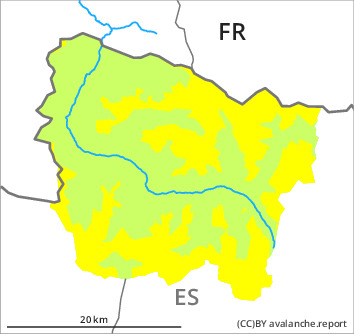
Danger level
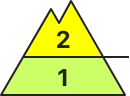
2400m
Avalanche Problem
Persistent weak layer

2400m

Wet snow



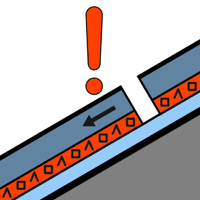
Weakly bonded old snow represents the main danger.
High altitudes, steep shady slopes: Weak layers in the upper part of the snowpack can still be released in some places. Sometimes the dry avalanches are medium-sized and can be released by a single winter sport participant. Caution is to be exercised adjacent to ridgelines and in gullies and bowls, as well as at the base of rock walls and behind abrupt changes in the terrain. As a consequence of a moderate to strong northwesterly wind, small wind slabs will form from the middle of the day in isolated cases.
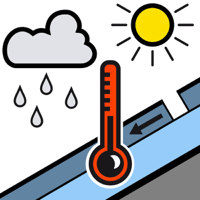
Very steep sunny slopes as well as low altitudes: As a consequence of warming during the day and solar radiation moist snow slides are possible as the day progresses, but they will be mostly small. Gliding avalanches can also occur.
The current avalanche situation calls for experience in the assessment of avalanche danger.
Very steep sunny slopes as well as low altitudes: As a consequence of warming during the day and solar radiation moist snow slides are possible as the day progresses, but they will be mostly small. Gliding avalanches can also occur.
The current avalanche situation calls for experience in the assessment of avalanche danger.
Snowpack
>
Wednesday: Until midday the weather will be sunny. The surface of the snowpack will freeze to form a strong crust and will soften during the day. The wind will be moderate to strong adjacent to ridgelines over a wide area. The northwesterly wind will transport the loosely bonded old snow. Some snow will fall from the afternoon.
In particular high altitudes in shady places that are protected from the wind: Large-grained weak layers exist in the top section of the snowpack. Stability tests indicate the unfavourable bonding of the snowpack in these regions.
At intermediate altitudes there are 100 to 200 cm of snow, and even more in some localities. Snow depths vary greatly at high altitudes and in high Alpine regions, depending on the infuence of the wind.
In particular high altitudes in shady places that are protected from the wind: Large-grained weak layers exist in the top section of the snowpack. Stability tests indicate the unfavourable bonding of the snowpack in these regions.
At intermediate altitudes there are 100 to 200 cm of snow, and even more in some localities. Snow depths vary greatly at high altitudes and in high Alpine regions, depending on the infuence of the wind.
Tendency
Thursday: Rapid decrease in danger of moist avalanches as the temperature drops. Slight increase in danger of dry avalanches as a consequence of the snowfall.