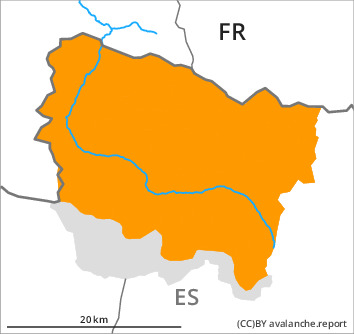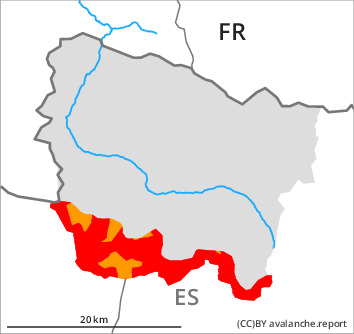
Danger level
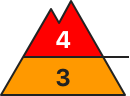
2000m
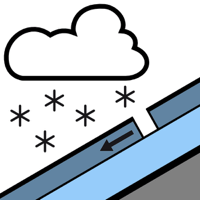
Avalanche Problem
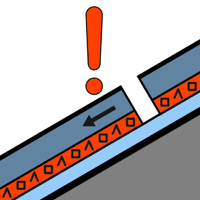
Persistent weak layer

2000m

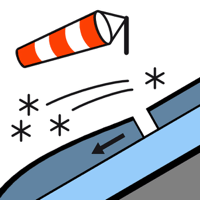
Wind slab
Treeline

The avalanche conditions are dangerous.
New snow and wind slabs until the early morning. Weakly bonded old snow on shady slopes.
As a consequence of new snow and wind dry snow slides and avalanches are to be expected at any time, even medium-sized ones. These can in many cases be released very easily or triggered naturally. The avalanche prone locations are to be found in all aspects and on wind-loaded slopes. Dry avalanches can be released in the weakly bonded old snow also. The avalanches in these loacations are dangerously large.
The avalanche prone locations are numerous and are barely recognisable because of the poor visibility. Backcountry touring and other off-piste activities call for extensive experience and great restraint.
The avalanche prone locations are numerous and are barely recognisable because of the poor visibility. Backcountry touring and other off-piste activities call for extensive experience and great restraint.
Snowpack
>
30 to 50 cm of snow, and even more in some localities, will fall until Sunday above approximately 1500 m. In particular above the tree line: The sometimes strong wind will transport the new snow. The new snow and wind slabs will become increasingly prone to triggering in particular on steep shady slopes and generally at intermediate and high altitudes. Distinct weak layers exist in the old snowpack in particular on little-used, rather lightly snow-covered west, north and east facing slopes.
At intermediate altitudes there are 80 to 120 cm of snow, and even more in some localities. At elevated altitudes snow depths vary greatly, depending on the infuence of the wind.
At intermediate altitudes there are 80 to 120 cm of snow, and even more in some localities. At elevated altitudes snow depths vary greatly, depending on the infuence of the wind.
Tendency
Monday: Gradual decrease in danger of dry avalanches as the snowfall eases.